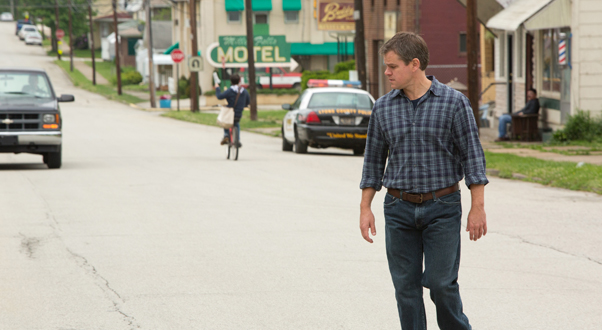
At Any Price is a disappointing stumble for New York-based, North Carolina-raised filmmaker Ramin Bahrani, especially after the leap forward that was his last film, 2008's Goodbye Solo. I hope it's a temporary aberration and not the first act of a sad decline. I'm keeping my fingers crossed.
Bahrani, the first-generation American son of Iranian immigrants, made three features of increasing excellence and the endearingly oddball comedic short Plastic Bag (with Werner Herzog as the voice of a plastic bag and music by a member of Sigur Ros) before the conventional, overheated At Any Price got the better of him, and it's been a pleasure to follow his career over the last eight years. His promising first two films, Man Push Cart, about a former Pakistani pop star struggling to make ends meet in Manhattan with his coffee and bagel cart, and the Italian neo-realist-inspired Chop Shop, about a couple of teenage orphans living above and working in the auto repair shops and scrapyards of the Willets Point area of Queens, made me take notice. They were good films with minor flaws, and they gave me the sense that Bahrani would have some great films ahead of him once he acquired a little age and experience.
The first (hopefully not the last) great Bahrani film appeared in 2008. The filmmaker returned to his home state of North Carolina for Goodbye Solo, a sad, funny, and visually beautiful story about a complex friendship between a Senegalese immigrant cab driver named Solo (Souleymane Sy Savane) and one of his fares in Winston-Salem, William (Red West, an actor, songwriter, and stuntman most famous for being an integral part of Elvis Presley's Memphis Mafia as a driver, bodyguard, songwriter, and close friend).
While that film ended with a hypnotic but emotionally intense, nearly dialogue-free, formally gorgeous long scene in North Carolina's Blue Ridge Mountains that relied on the composition of images, the landscape, the characters' faces, and meditative silence to tell the end of the story, At Any Price is full of long speeches, melodramatic outbursts, soapbox preaching, and a plot full of soap operatic twists and turns. The story of an Iowa farm family, the Whipples, and their ambitious patriarch Henry (Dennis Quaid), who has turned a small but successful family farm into a large agribusiness machine, the film is a confused mix of puffed-up melodrama and rural slice-of-life. Quaid's ready for his grown sons to enter the family business, but the unseen prodigal son is inexplicably climbing mountains in Argentina (his letters home, read in voice-over, provide some of the film's most ridiculous low points) and the younger son, Dean (Zac Efron) is more interested in breaking into NASCAR, getting into trouble with his redneck friends, taking his smart but younger girlfriend Cadence (the excellent Maika Monroe) for granted, and brooding and sulking in attempts to cultivate his sensitive bad-boy image. Meanwhile, Heather Graham has a thankless, one-note role as a former teen beauty stuck in her Iowa hometown who now sleeps with everyone, including Henry and Dean. Kim Dickens is the suffering, noble wife and mother. Clancy Brown is Henry's agribusiness competition, and Red West (thank god for Red West) is Henry's hard-assed, distant dad. We start at this fever-pitch of melodrama, and rev it up from there.
What happened? Look at how evocative the titles of Bahrani's previous films are. Then look at the flat, generic title of this one. Look at how Bahrani wrote his previous films either alone or with a friend and how he wrote this one with a professional writer. Look at how he swapped his casts of nonprofessionals and offbeat character actors for this cast of Hollywood pros. Look at how his previous films' visual palette gives way to the flat, anonymous look of this movie.
I will give Bahrani some credit. This is a disappointingly conventional film, but the conventions Bahrani follows here are currently unfashionable and unusual. The template for At Any Price is a combination of '50s melodrama and the late '70s/early '80s message movies about factories and farms like Norma Rae, The River, and Silkwood. At Any Price plays like a Joshua Logan period piece like Picnic or Bus Stop without the Technicolor, fun, and charisma or like a message movie with too much message. Still, it's an interesting choice of model in today's world of CGI action and rise-and-fall biopics in Hollywood and the inarticulate, distanced young urban bohemia in indie land. Bahrani gets the rural Midwestern landscape, speech patterns, and social life just right, and Clancy Brown, Red West, and Maika Monroe give better performances than the material deserves. The normally excellent Dennis Quaid (my wife is absolutely right when she says that every Kevin Costner movie would be substantially improved with Quaid in the Costner role) gives an oddly mannered performance, and Zac Efron can't do much with his silly character. I could get into the disastrous home movie montage that opens the film, but I don't have the heart. I'm guardedly optimistic for his next film, but any more like this one, and I may have to bow out.
Monday, August 26, 2013
Monday, August 05, 2013
I'm way behind #2: A Woman Under the Influence & Husbands (John Cassavetes)
The Austin Film Society hosted a mini-retrospective of my favorite filmmaker, John Cassavetes, a few months ago, giving me a chance to see two of my favorite movies on the big screen for the first time. (I skipped the third film in the series, The Killing of a Chinese Bookie, only because I caught that one on the big screen last year.) I almost talked myself out of going because of my temporarily shitty work schedule and because I've seen both films at least a dozen times, but Cassavetes' work has this insane hold on me that manages to blast through my strongest stores of inertia. If my arm was ripped off in a horrific industrial accident right before a Cassavetes screening, I would just slap a bunch of Band-Aids on it and head into the theater. I guess I'm saying I like these movies.
As much as I admire Cassavetes, I have a hard time understanding or agreeing with the ways his films, directorial style, screenplays, and methods have been described, praised, slammed, or represented by the media, fellow admirers, and irritated detractors alike. There are a lot of oft-repeated misconceptions about his work that have hardened into conventional wisdom. He has a reputation for being a sloppy technician and a maker of improvised, neo-realist films that are primarily actor-driven (acting exercises masquerading as narrative films to his non-fans). Many mediocre filmmakers claim they're making Cassavetes-inspired cinema when they throw some inexperienced actors into dialogue-driven, improvisation-heavy scenarios with manufactured revelations, framed in sloppy, stagy awkwardness. These films have about as much to do with Cassavetes as Cassavetes' films have to do with Star Wars.
Cassavetes' first two purely independent productions, Shadows and Faces (with two unhappy dalliances in Hollywood in between), do have some occasionally sloppy technical moments, due to the fact he and his collaborators were learning as they went with a nonprofessional crew, but Cassavetes became a graceful, accomplished visual stylist with an innate yet unconventional sense of composition and camera movement. He's partially responsible for the misunderstanding about his screenplays being mostly improvised on the set. Shadows ends with a title card reading, "The film you have just seen is an improvisation." That film was created from improvisations in an acting workshop Cassavetes ran with Burt Lane (Diane's dad) in the late 1950s, but the story and most of the dialogue was set in stone by the time the cameras rolled. Cassavetes' dialogue, with the exception of a handful of improvised lines, was scripted for the remainder of his career, and he instructed the actors not to deviate from the words on the page. What is improvised in Cassavetes' films is what makes them so peculiar and so emotionally affecting. The actors could move where they wanted and say the words in whatever cadence, volume, pace, and tone they wanted. Cassavetes avoided storyboards and marks. He lit and miked the entirety of the locations and sets so the actors were free to move around without worrying about having to stand in a particular spot or hit their marks. This freed them up to concentrate on the characters they were playing in more intuitive, experiential ways than the mainstream or independent filmmaking norm and to honestly and intuitively react to their fellow actors, but they still had to stick to the structure and words of the script. This was no sloppy acting exercise as movie. This was a carefully devised method, a serious approach to film form from a genuinely visually oriented filmmaker. He created a formal structure based on the movements and performances of his actors as well as the wonderful strangeness of his scripts, and he managed to do this without turning his movies into filmed plays. This was cinema, not theater. (To be clear, I'm not knocking theater here. I am knocking the unfair, inaccurate putdown of Cassavetes' work as uncinematic, theatrical exercises.)
I also take issue with the widespread characterization of Cassavetes' films as slices of life or documentary-like cinema verite. His films are far stranger than that. Though the emotions his films stir up in the empathetic viewer are visceral, real, and raw and some of his characters are everyday working people, his dialogue is a mixture of hysterical outbursts, tangents both mundane and bizarre, non sequiturs and jokes, singing, laughter, hairpin-turn shifts in tone, repetition, verbal tics, and naked emotion. He has a particular and stylized way of making his characters talk that is every bit as strange as any other unique writer of film dialogue. Beginning with The Killing of a Chinese Bookie, Cassavetes' films become dreamier, more melancholy, even stranger. The Crazy Horse strip club and cabaret in that film is Fellini by way of Ed Wood by way of an idealized burlesque house from remembered history. Opening Night contains several scenes of Gena Rowlands' actress character talking to the ghost of a teenaged fan killed in an accident. Gloria is Hollywood fantasy and escapism colliding with the Cassavetes method. Love Streams features multiple hallucinatory fantasy sequences and a musical number. The man doesn't get enough credit for being a visual stylist and formal innovator.
I can blather on about Cassavetes, can't I? Time to move my blather to the particular films at hand.
A Woman Under the Influence is probably Cassavetes' best-known film, with Gena Rowlands' deservedly famous, very intense embodiment of Mabel Longhetti, a housewife whose eccentricities push at the constrictions placed on her by herself, her family, and 1974 American society until they burst. Peter Falk is just as good as her equally eccentric (though his eccentricities are more socially acceptable) city construction worker husband. These are inadequate descriptions, as almost every description is when attempting to write about a Cassavetes film. These films follow their own beats, their own rhythms. They don't work like other movies. They're all Mabels.
I was surprised at how much I'd absorbed A Woman Under the Influence while watching it for the first time on the big screen. I had it down. I had it memorized. I knew every beat, every line of dialogue, what was coming next, how many scenes were left. I'd seen it so many times before, on video or DVD. But it was still a new experience. I don't know how he did it. Each viewing is like a first viewing. I feel differently about the characters every time I watch. This time, I was more disturbed by and less sympathetic to Peter Falk, but I still felt so much love for his character, and for all the characters. I love the way they move through the house, up and down the stairs, into the kitchen, into the living room. That house is a character, too. The day trip to the beach after Mabel is committed. The young kids drinking beer with their dad in the back of the pickup. This is a film that exhausts you, but it recharges you, too. The construction crew scenes have a greater impact on a big screen. They don't have the same intensity on the television. I don't know why. There are so many mysteries here, so much worth going back to again and again, but most people would rather watch Transformers 4. I don't know what else to say. This movie is worth your fucking time.
Husbands was different. I didn't have it memorized. I mean, I did. But I didn't. It played so differently on a big screen. I don't know why. I'd always loved it from the first time I saw it, but I didn't think it was one of his masterpieces. It was almost there, but it fell a little short. I have to revise that now. I've bumped it up to masterpiece status. The humor played well with a Friday night crowd. So did the tough stuff, the ugly stuff. It had an electrical charge to it, seeing it with an audience. That extra juice, that jump from being with a crowd who's also affected by it. After seeing it, I felt lonely but also a part of something. Those guys in Husbands. So likable. So unlikable. Such a rhythm to that movie. You go with them until it's time to stop, and then it just stops, right where it's supposed to stop. The greatest bender in movie history. These movies resist analysis, summing up, description. Look at all the words I've just wasted trying to tell you about something that can only be seen. Stop reading this shit and go see them.
As much as I admire Cassavetes, I have a hard time understanding or agreeing with the ways his films, directorial style, screenplays, and methods have been described, praised, slammed, or represented by the media, fellow admirers, and irritated detractors alike. There are a lot of oft-repeated misconceptions about his work that have hardened into conventional wisdom. He has a reputation for being a sloppy technician and a maker of improvised, neo-realist films that are primarily actor-driven (acting exercises masquerading as narrative films to his non-fans). Many mediocre filmmakers claim they're making Cassavetes-inspired cinema when they throw some inexperienced actors into dialogue-driven, improvisation-heavy scenarios with manufactured revelations, framed in sloppy, stagy awkwardness. These films have about as much to do with Cassavetes as Cassavetes' films have to do with Star Wars.
Cassavetes' first two purely independent productions, Shadows and Faces (with two unhappy dalliances in Hollywood in between), do have some occasionally sloppy technical moments, due to the fact he and his collaborators were learning as they went with a nonprofessional crew, but Cassavetes became a graceful, accomplished visual stylist with an innate yet unconventional sense of composition and camera movement. He's partially responsible for the misunderstanding about his screenplays being mostly improvised on the set. Shadows ends with a title card reading, "The film you have just seen is an improvisation." That film was created from improvisations in an acting workshop Cassavetes ran with Burt Lane (Diane's dad) in the late 1950s, but the story and most of the dialogue was set in stone by the time the cameras rolled. Cassavetes' dialogue, with the exception of a handful of improvised lines, was scripted for the remainder of his career, and he instructed the actors not to deviate from the words on the page. What is improvised in Cassavetes' films is what makes them so peculiar and so emotionally affecting. The actors could move where they wanted and say the words in whatever cadence, volume, pace, and tone they wanted. Cassavetes avoided storyboards and marks. He lit and miked the entirety of the locations and sets so the actors were free to move around without worrying about having to stand in a particular spot or hit their marks. This freed them up to concentrate on the characters they were playing in more intuitive, experiential ways than the mainstream or independent filmmaking norm and to honestly and intuitively react to their fellow actors, but they still had to stick to the structure and words of the script. This was no sloppy acting exercise as movie. This was a carefully devised method, a serious approach to film form from a genuinely visually oriented filmmaker. He created a formal structure based on the movements and performances of his actors as well as the wonderful strangeness of his scripts, and he managed to do this without turning his movies into filmed plays. This was cinema, not theater. (To be clear, I'm not knocking theater here. I am knocking the unfair, inaccurate putdown of Cassavetes' work as uncinematic, theatrical exercises.)
I also take issue with the widespread characterization of Cassavetes' films as slices of life or documentary-like cinema verite. His films are far stranger than that. Though the emotions his films stir up in the empathetic viewer are visceral, real, and raw and some of his characters are everyday working people, his dialogue is a mixture of hysterical outbursts, tangents both mundane and bizarre, non sequiturs and jokes, singing, laughter, hairpin-turn shifts in tone, repetition, verbal tics, and naked emotion. He has a particular and stylized way of making his characters talk that is every bit as strange as any other unique writer of film dialogue. Beginning with The Killing of a Chinese Bookie, Cassavetes' films become dreamier, more melancholy, even stranger. The Crazy Horse strip club and cabaret in that film is Fellini by way of Ed Wood by way of an idealized burlesque house from remembered history. Opening Night contains several scenes of Gena Rowlands' actress character talking to the ghost of a teenaged fan killed in an accident. Gloria is Hollywood fantasy and escapism colliding with the Cassavetes method. Love Streams features multiple hallucinatory fantasy sequences and a musical number. The man doesn't get enough credit for being a visual stylist and formal innovator.
I can blather on about Cassavetes, can't I? Time to move my blather to the particular films at hand.
A Woman Under the Influence is probably Cassavetes' best-known film, with Gena Rowlands' deservedly famous, very intense embodiment of Mabel Longhetti, a housewife whose eccentricities push at the constrictions placed on her by herself, her family, and 1974 American society until they burst. Peter Falk is just as good as her equally eccentric (though his eccentricities are more socially acceptable) city construction worker husband. These are inadequate descriptions, as almost every description is when attempting to write about a Cassavetes film. These films follow their own beats, their own rhythms. They don't work like other movies. They're all Mabels.
I was surprised at how much I'd absorbed A Woman Under the Influence while watching it for the first time on the big screen. I had it down. I had it memorized. I knew every beat, every line of dialogue, what was coming next, how many scenes were left. I'd seen it so many times before, on video or DVD. But it was still a new experience. I don't know how he did it. Each viewing is like a first viewing. I feel differently about the characters every time I watch. This time, I was more disturbed by and less sympathetic to Peter Falk, but I still felt so much love for his character, and for all the characters. I love the way they move through the house, up and down the stairs, into the kitchen, into the living room. That house is a character, too. The day trip to the beach after Mabel is committed. The young kids drinking beer with their dad in the back of the pickup. This is a film that exhausts you, but it recharges you, too. The construction crew scenes have a greater impact on a big screen. They don't have the same intensity on the television. I don't know why. There are so many mysteries here, so much worth going back to again and again, but most people would rather watch Transformers 4. I don't know what else to say. This movie is worth your fucking time.
Husbands was different. I didn't have it memorized. I mean, I did. But I didn't. It played so differently on a big screen. I don't know why. I'd always loved it from the first time I saw it, but I didn't think it was one of his masterpieces. It was almost there, but it fell a little short. I have to revise that now. I've bumped it up to masterpiece status. The humor played well with a Friday night crowd. So did the tough stuff, the ugly stuff. It had an electrical charge to it, seeing it with an audience. That extra juice, that jump from being with a crowd who's also affected by it. After seeing it, I felt lonely but also a part of something. Those guys in Husbands. So likable. So unlikable. Such a rhythm to that movie. You go with them until it's time to stop, and then it just stops, right where it's supposed to stop. The greatest bender in movie history. These movies resist analysis, summing up, description. Look at all the words I've just wasted trying to tell you about something that can only be seen. Stop reading this shit and go see them.
Wednesday, July 24, 2013
I'm way behind #1: Post Tenebras Lux (Carlos Reygadas)
When I decided to start writing about every film I see in a theater, I thought I could stay on top of things. I didn't count on a temporarily inconvenient work schedule and my innate laziness, and now I'm almost three months behind. I plan to rectify the situation with a series I'm calling "I'm way behind."
I may be a misguided fool, but, to me, Mexican writer/director Carlos Reygadas is an anomaly. He makes films as if the last 35 years of prevailing trends in both mainstream and arthouse cinema never happened, but his films aren't retro-nostalgia throwbacks. They feel very contemporary, but you'd have to go back to people like Dreyer, Tarkovsky, Bresson, "trilogy of faith"-era Bergman, the Herzog of Aguirre, and the Erice of Spirit of the Beehive to find a similar ambition and tone. He makes visionary, emotional epics on an intimate scale with mixed casts of professional and nonprofessional actors in Mexican landscapes and communities free from the usual cinematic cliches of what that country looks like. His films are largely meditative and slowly paced, but they contain outrageous moments of apocalyptic/mystical provocation and psychedelic lunacy, and his approach to sexuality and nudity walks a thin line between matter-of-factness and titillation. His shot composition is remarkably beautiful, with a subtle undercurrent of menace. He's an artist, not an entertainer or commercial huckster, but there is just enough P.T. Barnum in him to make the viewing experience slightly unsettling.
I have yet to catch up with his first film, Japon, but the two preceding Post Tenebras Lux, Battle in Heaven and his Dreyer homage Silent Light, may be two of my favorite films of the past decade. Silent Light, in particular, gave me a glimpse into a community I'd never known about previously, the white Mennonite settlements in Chihuahua that have existed since the 1920s. The film was the first made in Plautdietsch, the dialect spoken by low-German Mennonites. Those two films were well received by critics, but Post Tenebras Lux is a much more divisive animal. An abstract semi-autobiography of fragmented narrative, Post Tenebras Lux features Reygadas' children playing the lead characters' children, uses Reygadas' house as a primary location, and includes two scenes of English boys playing rugby, which initially baffled me until I read some biographical information about the director and discovered the rugby teams were affiliated with an English boarding school Reygadas attended as a boy. This impressionistic approach to narrative and form has made some critics pull out that old saw of an insult, "self-indulgent," but I think their problem is that Reygadas is not indulging or validating their own laziness, prejudice, and lack of engagement.
The film opens with a virtuosic piece of filmmaking; Reygadas' young daughter Rut wanders unsupervised in a rural, mountainous landscape at dusk while dogs and cattle move about her and a thunderstorm punctuates the enormous sky with yellows and purples and huge claps of percussive sound. The rest of the film can't quite live up to this visual embarrassment of riches (though it comes close), but what other film of the last thirty years could?
The rest of Post Tenebras Lux includes both quiet and fraught domestic moments, an animated devil wandering the home at night, a transformative sexual experience in a French bathhouse, a robbery gone bad, an off-key but emotionally affecting Neil Young cover, a meeting of recovering addicts in a reconfigured shack, reverently mystical shots of the landscape, and the most unexpected sacrificial atonement of sins you'll probably ever see. The film was shot in the rarely used 1:33 aspect ratio that is square instead of rectangular. Reygadas also shoots his exterior scenes with a distortion effect around the edges of the frame that makes the viewer feel as if he's staring through glass. Rather than the pretentious distraction this sounds like on paper, the lens distortion has the effect of making the film seem like a dream or hallucination, as well as setting it apart from conventional filmmaking technique and forcing the viewer to acknowledge it as a piece of art on its own terms, a personal expression from a man with a very particular way of looking at the world. I'm grateful to have had the opportunity to see it on a theater screen.
I may be a misguided fool, but, to me, Mexican writer/director Carlos Reygadas is an anomaly. He makes films as if the last 35 years of prevailing trends in both mainstream and arthouse cinema never happened, but his films aren't retro-nostalgia throwbacks. They feel very contemporary, but you'd have to go back to people like Dreyer, Tarkovsky, Bresson, "trilogy of faith"-era Bergman, the Herzog of Aguirre, and the Erice of Spirit of the Beehive to find a similar ambition and tone. He makes visionary, emotional epics on an intimate scale with mixed casts of professional and nonprofessional actors in Mexican landscapes and communities free from the usual cinematic cliches of what that country looks like. His films are largely meditative and slowly paced, but they contain outrageous moments of apocalyptic/mystical provocation and psychedelic lunacy, and his approach to sexuality and nudity walks a thin line between matter-of-factness and titillation. His shot composition is remarkably beautiful, with a subtle undercurrent of menace. He's an artist, not an entertainer or commercial huckster, but there is just enough P.T. Barnum in him to make the viewing experience slightly unsettling.
I have yet to catch up with his first film, Japon, but the two preceding Post Tenebras Lux, Battle in Heaven and his Dreyer homage Silent Light, may be two of my favorite films of the past decade. Silent Light, in particular, gave me a glimpse into a community I'd never known about previously, the white Mennonite settlements in Chihuahua that have existed since the 1920s. The film was the first made in Plautdietsch, the dialect spoken by low-German Mennonites. Those two films were well received by critics, but Post Tenebras Lux is a much more divisive animal. An abstract semi-autobiography of fragmented narrative, Post Tenebras Lux features Reygadas' children playing the lead characters' children, uses Reygadas' house as a primary location, and includes two scenes of English boys playing rugby, which initially baffled me until I read some biographical information about the director and discovered the rugby teams were affiliated with an English boarding school Reygadas attended as a boy. This impressionistic approach to narrative and form has made some critics pull out that old saw of an insult, "self-indulgent," but I think their problem is that Reygadas is not indulging or validating their own laziness, prejudice, and lack of engagement.
The film opens with a virtuosic piece of filmmaking; Reygadas' young daughter Rut wanders unsupervised in a rural, mountainous landscape at dusk while dogs and cattle move about her and a thunderstorm punctuates the enormous sky with yellows and purples and huge claps of percussive sound. The rest of the film can't quite live up to this visual embarrassment of riches (though it comes close), but what other film of the last thirty years could?
The rest of Post Tenebras Lux includes both quiet and fraught domestic moments, an animated devil wandering the home at night, a transformative sexual experience in a French bathhouse, a robbery gone bad, an off-key but emotionally affecting Neil Young cover, a meeting of recovering addicts in a reconfigured shack, reverently mystical shots of the landscape, and the most unexpected sacrificial atonement of sins you'll probably ever see. The film was shot in the rarely used 1:33 aspect ratio that is square instead of rectangular. Reygadas also shoots his exterior scenes with a distortion effect around the edges of the frame that makes the viewer feel as if he's staring through glass. Rather than the pretentious distraction this sounds like on paper, the lens distortion has the effect of making the film seem like a dream or hallucination, as well as setting it apart from conventional filmmaking technique and forcing the viewer to acknowledge it as a piece of art on its own terms, a personal expression from a man with a very particular way of looking at the world. I'm grateful to have had the opportunity to see it on a theater screen.
Friday, May 03, 2013
Malick, Gondry, Nichols
To the Wonder (Terrence Malick)
Though To the Wonder is very much a companion piece to Malick's previous film, The Tree of Life, in style, structure, and subject matter, it marks a couple unique firsts for the director. Excepting a few scenes of Sean Penn gazing pensively out of a Houston high-rise window in The Tree of Life, this is Malick's first film set in the present. Even more shockingly, To the Wonder arrived in theaters less than two years after The Tree of Life. This is unprecedented for a guy who took twenty years to follow up his second film and whose shortest previous gap between releases was five years. Malick, who is currently making two (possibly three) films simultaneously, is entering a prolific phase, though I'm not sure that's a good thing. I greatly admired The Tree of Life, and I like To the Wonder more than I dislike it, but I have some major reservations. If Malick continues in this vein, I'm worried the formal techniques he's grown fond of in his last three films will become crutches. He's coming dangerously close to self-parody, and though I admire anyone honest enough to get that close to ridiculousness, I can feel my tolerance for self-consciously poetic voice-over, Christian mysticism, ethereally floating camera movement, sunlight peeking through trees, and childlike women twirling their skirts stretching to the breaking point. Every Malick film has used poetic, impressionistic voice-over and placed even the strongest characters in a natural, beautiful landscape that puts the smallness of their individual egos and existences into perspective, and has used major Hollywood stars deeply against type as figures in a landscape instead of as bright, shining, charisma machines who are more special than their audiences. However, Malick's style changed beginning with 2005's The New World, though there were some hints of this direction in 1998's The Thin Red Line. His camera started floating above and below his actors and around the frame like a hovering spirit, the narrative became far more abstract, impressionistic, and plotless (shapeless and formless, if you're a detractor), and the voice-over became much more self-consciously poetic, philosophical, and overtly Christian (or pretentious and sometimes silly if this approach is not in your wheelhouse). Gone was the humor, strange improvisatory non-sequiturs, and matter-of-fact observation of mundane details in the voice-over work of Martin Sheen and Sissy Spacek in Badlands and Linda Manz in Days of Heaven. I miss that Malick.
To the Wonder is Malick's most minimal and abstract narrative. Ben Affleck is billed as the lead, but he barely speaks and is almost always shown in side profile. I admire this unconventional use of a Hollywood star, though it drove the middle-aged women seated behind me crazy. (Their loud take on the film after it ended: "To the Wonder, huh? Well, I wonder what that was about." They then spent a few minutes loudly trying to piece together a plot like it was a generic Hollywood film.) Instead, the film is really about two women who try to maintain relationships with him (Olga Kurylenko and Rachel McAdams) and a depressed priest (Javier Bardem) trying to work through a crisis of faith. Bardem loves God but feels God is inaccessible and unavailable to his suffering followers, while Kurylenko and McAdams try to maintain their love for the emotionally distant Affleck. There are beautiful images throughout, and lots to chew over afterwards, but Kurylenko is frustratingly childish, constantly twirling, twirling, twirling her skirt, dancing, jumping on the bed, lying on the ground, rubbing her face on flowers, leaves, and rocks. No grown woman acts like this. Still, there's too much of value here to dismiss it for its substantial flaws. A frustrating, rewarding film.
The We and the I (Michel Gondry)
Far better, though far harder to see, is Michel Gondry's latest, which screened only one time in Austin. Gondry, inspired by a Paris bus ride that saw a group of teenagers board after the school day ended, wrote a brief scenario and approached several New York City schools about making a film with their students. The schools passed for insurance reasons, but an after-school program in the Bronx said yes. Gondry taught a workshop for the teenagers to create the characters and give them some acting experience, and enlisted two screenwriters, Jeffrey Grimshaw and Paul Proch, to help him turn the workshop and story idea into a feature. The film takes place on the last day of school, almost entirely on a city bus (though Gondry punctuates the narrative with comedic fantasy sequences and a documentary-style flashback to a traumatic event in one student's life). The students board, and we follow their shifting relationships, conversations, cruelties, kindnesses, and alliances as the number grows smaller at each stop. The kids are amazing, gifted, natural actors, the emotions are earned, not forced, and Gondry's camera catches it all. It's a funny, sad, sweet, tough, honest movie, and the fact that the film is not playing widely in every theater in the country is just one more sad indictment of our bullshit mainstream culture.
Mud (Jeff Nichols)
Mud is very good and is actually playing to wide audiences, but it stars Matthew McConaughey and Reese Witherspoon, so the odds are in its favor for adequate distribution. With Mud, Nichols continues the hot streak he began with his first two films, Shotgun Stories and Take Shelter. He builds unusual films from classic situations, is excellent with actors and landscapes, and creates movies that have the feel of a great Southern novel. Mud is more accessible and conventional than Nichols' first two films without sacrificing any of his strengths and could set him up for a long, successful career. A Huck Finn boys' adventure story married to a Southern noir crime thriller, Mud is primarily about the difficulties and joys of love and friendship. Nichols is a skilled storyteller with an innate understanding of character and pacing, and he pulls great performances out of the two child leads, The Tree of Life's Tye Sheridan and Jacob Lofland, the big movie stars, and the sharp assemblage of character actors rounding out the cast, including his go-to guy Michael Shannon, Sam Shepard, Sarah Paulson, Ray McKinnon, Paul Sparks, and Joe Don Baker. The McConaughey redemption continues! At this point, I'm just going to pretend he made Dazed and Confused and Lone Star and then retired for twenty years before coming back to movies last year. Fair enough?
P.S. Mud has my favorite line of dialogue of the year. Sheridan goes to the trailer of Lofland and his uncle (Michael Shannon). Lofland is sitting on the steps outside while the Beach Boys' "Help Me, Rhonda" blares from within. Lofland: "Hold on. We can't go inside yet. He's doin' it. That's his doin' it song."
Wednesday, April 10, 2013
R.I.P. Bigas Luna and Les Blank
This is a bad month for film. Directors Bigas Luna and Les Blank both died of cancer this past weekend. I have only seen two films each from Luna and Blank, but they were enough to make me a fan, and I'm looking forward to exploring the rest of what they had to offer.
Bigas Luna was sometimes called the Spanish Russ Meyer, which is unfairly reductive, but both men shared a lunatic visual invention, a great sense of humor, and an obsession with breasts. Luna was very much his own man, however, and I strongly recommend the two Luna films I've seen, Anguish and Jamon Jamon. Anguish, an English-language postmodern horror film from 1987, renders foolish anyone who holds up Wes Craven's Scream as an exemplar of meta-horror. Luna's film is a structurally ambitious commentary about how we watch horror films while never forgetting to be a great horror film (maybe even two great horror films), and it does it with more intelligence, humor, respect, excitement, visual invention, beauty, and affection than Craven's obvious, irritating smugfest. Jamon Jamon is an almost indescribable mix of dark comedy, light comedy, live-action cartoon, doomed romance, advertising satire, soap opera, tragedy, critique of Spanish machismo culture, and T&A sex comedy, with early roles for Penelope Cruz and Javier Bardem. Luna films an epic fight scene in which both parties batter each other with generous cuts of pig meat, and another scene prominently features a parrot contributing to something I've definitely never seen in any other film. I'd also like to mention that both movies are massively entertaining and fun in addition to their artistic merits.
The two Les Blank films I've seen have Werner Herzog as their subject. The feature-length Burden of Dreams documents the tortuous making of Fitzcarraldo while the short film Werner Herzog Eats His Shoe shows Herzog making good on the bet he made with Errol Morris that Morris would never finish Gates of Heaven. It's a testament to Blank's skills that the films are admired by both Herzog fans and detractors. Burden of Dreams is a particularly strong look at the folly, hubris, passion, insanity, and drive needed to create art in difficult conditions and a critique of some negative consequences of that drive on the indigenous population and environment. Besides his work about Herzog, Blank made documentaries about garlic, buck-toothed women, Southern music, beer, Creole cooking, and Huey Lewis & The News, among many other subjects.
Bigas Luna was sometimes called the Spanish Russ Meyer, which is unfairly reductive, but both men shared a lunatic visual invention, a great sense of humor, and an obsession with breasts. Luna was very much his own man, however, and I strongly recommend the two Luna films I've seen, Anguish and Jamon Jamon. Anguish, an English-language postmodern horror film from 1987, renders foolish anyone who holds up Wes Craven's Scream as an exemplar of meta-horror. Luna's film is a structurally ambitious commentary about how we watch horror films while never forgetting to be a great horror film (maybe even two great horror films), and it does it with more intelligence, humor, respect, excitement, visual invention, beauty, and affection than Craven's obvious, irritating smugfest. Jamon Jamon is an almost indescribable mix of dark comedy, light comedy, live-action cartoon, doomed romance, advertising satire, soap opera, tragedy, critique of Spanish machismo culture, and T&A sex comedy, with early roles for Penelope Cruz and Javier Bardem. Luna films an epic fight scene in which both parties batter each other with generous cuts of pig meat, and another scene prominently features a parrot contributing to something I've definitely never seen in any other film. I'd also like to mention that both movies are massively entertaining and fun in addition to their artistic merits.
The two Les Blank films I've seen have Werner Herzog as their subject. The feature-length Burden of Dreams documents the tortuous making of Fitzcarraldo while the short film Werner Herzog Eats His Shoe shows Herzog making good on the bet he made with Errol Morris that Morris would never finish Gates of Heaven. It's a testament to Blank's skills that the films are admired by both Herzog fans and detractors. Burden of Dreams is a particularly strong look at the folly, hubris, passion, insanity, and drive needed to create art in difficult conditions and a critique of some negative consequences of that drive on the indigenous population and environment. Besides his work about Herzog, Blank made documentaries about garlic, buck-toothed women, Southern music, beer, Creole cooking, and Huey Lewis & The News, among many other subjects.
Saturday, April 06, 2013
Roger Ebert 1942-2013

I don't know how a guy like me from a town of 1,500 people in small-town Nebraska, four hours' drive from the nearest major city (Denver), became obsessed with music, movies, and literature when most of my peers were into sports, shopping, guns, sitcoms, blockbusters, racism, sexism, chewing tobacco, church, and top 40 radio (I'm being unfairly reductive here, but just a little unfairly reductive). I just don't know. I loved the arts from the second I could walk and talk, and this love was stronger than the pressure of a local environment that was either openly hostile or completely indifferent to anything diverting from my laundry list above.
I was fortunate growing up to have a mother and grandmother that actively encouraged my love of reading and curiosity about experiences outside myself. My father has never read anything voluntarily in his life, but he also never discouraged anything his kids loved. In one of Roger Ebert's best pieces of writing, an essay about his father called "My Old Man," he wrote beautifully about receiving that same encouragement from his father. I felt a kinship to Roger Ebert, besides our shared loves of books and movies. We both grew up in small Midwestern towns to working-class parents of German and Irish heritage. We were both raised Catholic, served as altar boys, and became agnostics. Ebert loved science fiction as a child, while I was obsessed with horror. We both received English and journalism degrees and wrote for our college newspapers. Ebert, of course, was professionally successful from a young age, while I have consistently failed in every professional endeavor I've tried, thwarted by unemployment, a bad economy, blown opportunities, my own depression and inertia, bitterness, inability to schmooze and network, and just plain bad luck (also maybe a lack of talent), but I've still got some living in me, and Ebert is a great role model for how to live well.
As a child in the 1980s, I became a regular viewer of Gene Siskel and Roger Ebert's television program. Pre-Internet, I had no idea they were newspaper reviewers. I just loved seeing two regular-looking guys debate movies on television. "These guys love movies the way I love music," I remember thinking. When I worked for my college newspaper as an Arts & Entertainment reporter and reviewer and copy desk chief, I would often hang out after my shift was done to surf the web and work on papers for my classes. It was there I started reading Ebert's reviews regularly. I never stopped. I enjoyed his unaffected, conversational style and his deep love of film. So many TV and newspaper film critics in this country approach film criticism with condescension, like the movies are a goof, a diversion, something to inspire pithy, dismissive one-liners or cliched superlatives. Siskel and Ebert were the only mainstream TV critics to regularly feature foreign films, lower profile independents, and classic Hollywood movies alongside the blockbusters, Oscar bait, and high-profile independents, and Ebert was one of the only mainstream newspaper critics to do the same.
Ebert was a gateway to wonderful things. His taste was populist enough to earn a large mainstream following, but open and curious enough to champion the likes of Werner Herzog, John Cassavetes, Rainer Werner Fassbinder, Terrence Malick, Yasujiro Ozu, Eric Rohmer, Bela Tarr, Dusan Makevejev, and Carl Dreyer. Ebert was also the first American critic to review Martin Scorsese and Mike Leigh, and he became a lifelong supporter of both filmmakers. History has vindicated his loud support of Bonnie and Clyde and Bring Me the Head of Alfredo Garcia at a time when most critics were trashing these films. And he got Do the Right Thing in a way most white critics didn't. Also, he co-wrote three Russ Meyer films, four if you count the aborted Sex Pistols movie that didn't happen because Meyer and Malcolm McLaren didn't get along. (The film eventually morphed into Julien Temple's The Great Rock 'n' Roll Swindle, which is pretty great in its own right.) He's probably the only guy who wrote a book about rice cookers and collaborated with Russ Meyer.
He wasn't infallible. I can only shake my head sadly at his negative reviews of Raising Arizona, To Sleep with Anger, Dead Man, Fast Times at Ridgemont High, Romero's Day of the Dead, Husbands, The Chelsea Girls (the only non-narrative/experimental film he reviewed), Cosmopolis, Full Metal Jacket, Blue Velvet, Rushmore, The Passenger, and Abbas Kiarostami's entire filmography. (To his credit, he changed his mind about The Passenger upon its rerelease. He also came around on Tarkovsky and Blade Runner.) He praised Christopher Nolan, Oliver Stone, and "serious" Steven Spielberg too highly, and I don't know what he saw in Paul Haggis' Crash, his favorite film of the year and one of my least favorite viewing experiences ever. But that was part of the fun of reading him. He made you see what he saw for a few minutes.
He went into every film hoping to like it, without prejudice. I loved that. He praised The Straight Story and Mulholland Drive after disliking every other David Lynch film when most other critics would have given up on a director who consistently disappointed them. He was criticized for giving too many three-star reviews and liking too many movies. (My favorite moment of Siskel and Ebert: After Ebert gave the Burt Reynolds/cute kid buddy cop fiasco Cop and a Half a thumbs up, a stunned Siskel replied, barely able to contain his laughter: "Where's your hat and beard, Santa? You just gave these filmmakers a gift.") Maybe he was too soft on too many movies, but that was part of his kindness and openness. I've been accused by several friends of liking everything when it comes to music, as if that's a negative. Maybe I am a little soft critically when it comes to music, but it's the only thing in life I can't be cynical about. I love every genre of music and I'm loyal to every band I love even when they put out a less than stellar album, and I refuse to feel bad about that. Ebert went into every screening with an open mind, not a superior one.
Ebert was also a consistent supporter of his fellow film critics, even those critics who consistently criticized his own work. He led me to great film writers like Jonathan Rosenbaum, Dave Kehr, J. Hoberman, Andrew Sarris, Manny Farber, Robert Warshow, James Agee, and his website editor, Jim Emerson. In many ways, these critics are closer to my aesthetic taste than Ebert, especially in the last years of his life, but Ebert was the one who led me to them, and I'm forever grateful. In the last few years, Ebert gave essay space on his site to many of his regular blog commenters from around the world. He was that rare breed of strongly opinionated man who was deeply interested in the differing opinions of others.
His series of essays about his personal canon of the best films ever made, "Great Movies," is a wonderful place to get the fundamentals of a film education. I made it a point to see every one I hadn't already seen. There's a real poignancy about his final Great Movie, posted two weeks ago. The 1958 Japanese film The Ballad of Narayama is a Kabuki-style color film about a small village that forces its elderly residents to go to a mountain on the occasion of their 70th birthdays and starve to death.
Ebert lost most of his lower jaw and his ability to speak and eat due to complications of reconstructive surgery after his third bout with cancer in 2006. For a man who loved conversation and food, this could have been a death sentence. Instead, Ebert threw himself even deeper into writing. The number of movie reviews increased, but he also joined Twitter and started a blog, where he wrote the best work of his life. The essay about his father I linked to above is such a wonderfully detailed piece of writing, but so many other essays were just as inspiring, including several about his struggles with poor health and the strength he drew from his wife Chaz.
I don't know when Ebert slept. He found time to personally respond to many emails and blog comments. Several friends and acquaintances of mine have received a message from Ebert. He emailed me once about a comment I left on his site and responded to another one on his blog. When he trashed Dogville and claimed that most critics and audiences hated it, I wrote him with a defense of it, mentioning that two of his favorite critics, Kehr and Sarris, had praised the film and also relaying that my mother loved it. He wrote me back to tell me that I should be glad I have such an unusual mother. I loved that. I can't be sure, but I think he may have read this very site once. When I left the Dogville comment, I linked to this blog. My most recent post was a rave for Luis Bunuel's final film, That Obscure Object of Desire. Shortly after he responded to my comment, he made That Obscure Object of Desire his Overlooked DVD of the Week pick. Coincidence? Maybe. For my own vanity, I'd like to think it wasn't.
Checking Ebert's site has been a daily habit for me. I'm glad Jim Emerson and Chaz Ebert have both mentioned maintaining the site. I'm sad about all the movies Ebert is going to miss, and I'm going to miss reading him. I'm only being partially hyperbolic when I say it feels like I lost a friend.
Friday, April 05, 2013
The return of the son of recent business
Like Someone In Love (Abbas Kiarostami)Kiarostami, one of the greatest filmmakers of the last half-century, left his native country of Iran shortly before his good friend and fellow filmmaker, Jafar Panahi, was arrested, imprisoned, and banned from filmmaking for 20 years on a fabricated charge. Formerly content to ban or censor its best artists' work at home while allowing distribution and exhibition abroad, the Iranian government's suppression of its artists has become far more sinister in recent years. Having never made a bad film, Kiarostami was hardly in need of an artistic rejuvenation. Nevertheless, his two fiction features made outside of Iran have been career high points, despite the sad circumstances leading to their existence. Kiarostami filmed 2010's Certified Copy in Italy with French and British leads (Juliette Binoche and opera singer William Shimell) and dialogue in Italian, French, and English. His new film, shot in and around Tokyo with an all-Japanese cast, is objectively distanced from its characters yet empathetic, and both seductive and unsettling. Taking place over the course of one night and part of the following day, the film follows a college student moonlighting as an upscale call girl, her unstable ex-boyfriend, and an elderly retired sociology professor, most likely widowed, and the strange yet strangely ordinary set of circumstances that bring them into each other's orbit. Despite a landscape and culture, and exterior and interior spaces, quite different from the Iran of Kiarostami's earlier films, most of his trademarks are here. Kiarostami remains the best director of scenes shot inside cars we have, but he's also great at showing how people look (and look past) each other and how they organize, understand, and move through physical space. Kiarostami's endings are always open doors, never closed ones, but even by his standards, Like Someone in Love concludes with a sharp apathy-killing jolt that has kept the film turning in my mind since the second it ended. This is the film of a free man, and I don't mean his geographical location or the political constrictions or lack thereof of its government.
Spring Breakers (Harmony Korine)Spring Breakers opens in a neon hell of interchangeable tanned bodies chugging beers, flashing body parts, and grinding and groping each other in a predetermined robotic debauch to Skrillex's "Scary Monsters and Nice Sprites" and ends in a hail of bullets. Korine, though his detractors will never admit it, is a skilled visual artist with a talent for creating images never before seen on a screen. Though Spring Break is well-trod territory, Korine manages to make it look as strange and ugly-beautiful as anything else in his filmography. With a color palette channeling Skittles and Starburst, Spring Breakers is a candy-neon incantatory art film with a beach party titties'n'guns exploitation veneer. Korine makes excellent use of repetition, as scenes are shown multiple times from different perspectives and dialogue is repeated and layered, chopped up and rearranged in different contexts. One particularly impressive piece of filmmaking captures a diner robbery in a single take from the perspective of the getaway car as the driver circles the building, but there are lots of other highlights. The ex-Disney girls in bikinis hook has already made Korine more money in one week than his four previous films combined, and he deserves it.
Stoker (Park Chan-Wook)Park Chan-Wook ties everything in this post together. Harmony Korine has a cameo as a high school art teacher, and like Korine in Spring Breakers, Park in Stoker uses repetition of images and dialogue and the same events from different visual perspectives to create an incantatory effect. Like Kiarostami, Park is working in a country and a language he's never worked in before. The South Korean Park has made his first English-language, American film, and though he's working with a bit of an overheated screenplay by Prison Break actor Wentworth Miller, Park's stunning visual prowess elevates this one above its flaws. Besides the sheer virtuosity of many of its shots, Stoker contains several striking closeups of its actors' faces, with a particular emphasis on their sharp eyes. A Gothic thriller with nods to Hitchcock, Stoker takes place in an indeterminate time period that seems to exist in several decades at once, much like the otherwise very different films of Wes Anderson and Quentin Tarantino. Park has made the adjustment to American cinema without sacrificing too many of his strengths.
Tuesday, March 05, 2013
Happy People: A Year in the Taiga (Dmitry Vasyukov & Werner Herzog)
Like his earlier Grizzly Man, Werner Herzog's latest documentary is carved from another filmmaker's work. Even placed in this context, however, Happy People stands apart from the rest of Herzog's filmography. Though the bulk of Grizzly Man consisted of Timothy Treadwell's footage, Herzog visited the same locations as Treadwell and filmed new interviews with the people who knew him. Happy People does not contain a single frame shot by Herzog, and the globetrotting director never visited the location. Instead, all footage comes from Russian documentarian Dmitry Vasyukov's four-part Russian television miniseries. Herzog watched the miniseries at a friend's home in Los Angeles, fell in love with it, and contacted Vasyukov with an idea. Herzog wanted to edit the 8-hour miniseries into a 90-minute feature, with his own new voiceover narration. Vasyukov gave Herzog his blessing, and this film is the result, with both men credited as directors, though Herzog is more of a remixer than director here.
The film spends a year in the remote Siberian Taiga, focusing on a handful of men carving out a mostly self-sufficient existence in some intensely rugged conditions. We see men building canoes and skis, hunting, fishing, trapping animals, training their dogs, making temporary but sturdy shacks to spend the isolated hunting pilgrimages during the winter months, creating mosquito repellent from the bark of a tree during the summer months. These are some of Herzog's pet subjects, these driven, determined men doing difficult things in hostile, strange, and beautiful landscapes. The cameras required to shoot in this inhospitable terrain produce images that are flatter and muddier than we are used to seeing in a film with Herzog's name on it, but they capture scenes that fit right in to his body of work. Some of the most beautiful images approach Herzog's talent for making natural landscapes and the people in them look mythic, mystical, and alien. I particularly loved the underwater camera following fish below the ice, a snowmobile gliding through a forest of white, and fishermen in canoes at night, lit torches attached to the front of their crafts to attract fish. And a moment when a campaigning politician pulls up to shore in a giant boat, women dressed in white behind him singing a schmaltzy ode to positivity while an indifferent, bemused crowd of Siberians goes about its business finds a place in Herzog's gallery of eccentric futility.
Herzog's narration and need to constantly mythologize can occasionally grate, as when he gives a speech a Tea Party member might love about the men needing no taxes or government. "No women, either," my wife turned to me to say near the conclusion of this speech. The film is surprisingly uninterested in the women and children who occasionally wander into frame. Maybe this was Vasyukov's failing, but another interesting film about them is buried here.
Still, this is a lovable little film well worth seeing.
Sunday, February 24, 2013
Recent business
I've had the urge to get back into doing a little more writing on this blog, so I'm going to start posting about movies I watch in the theater. This is what I've seen so far this year.
Not Fade Away (David Chase)
The first film from the creator of The Sopranos, David Chase, has quickly come and gone without much media hubbub, hoopla, hyperbole, or ham giveaways (I ran out of alliterative descriptors before that last one, but I was on a roll. Forgive me.) This is a damn shame. The Sopranos is my favorite television drama, and though Chase's film doesn't come close to the formal beauty or emotional impact of that amazing show (how could it?), it does have a hell of a lot more ideas, earned emotion, and entertainment value than most recent American films. Like The Sopranos, Not Fade Away energizes and transforms a familiar story by telling it in a personal, unusual way. Chase's semi-autobiographical period piece is about a young rock band in suburban New Jersey in the early-to-mid 1960s, particularly drummer-turned-singer Douglas (John Magaro) and his family and friends. Despite a few embarrassing scenes and lines of dialogue, Chase largely succeeds in creating a world that feels almost as lived-in as his TV show. Chase's subject matter is familiar territory in terms of setting, period, and chain of events (suburban white America, the '60s, youth culture, coming of age, a rock band trying to make it, the generation gap), but he structures the film as a series of ellipses that skip events and chunks of time that have been belabored by earlier works. Cliches are avoided by simply skipping over any scene that would provide it. For example, Douglas and his girlfriend have a horrible fight and break up. The next scene takes place several months later, and they are once again together, but Chase doesn't bother showing how or why the two patched things up. And the band never makes it big, so we avoid the whole spectacular rise and fall and rise again nonsense American film is so damn obsessed with retelling. Instead, like most bands, they don't have what it takes and simply fizzle out. They're an above average suburban New Jersey bar band with a couple good originals, and that's it. Not Fade Away's final moments are as gorgeous and daring as the final Sopranos episode, and probably just as likely to piss off any viewer who needs every conclusion tidy and final so it can be safely tucked into bed in time for the next diversion.
Promised Land (Gus Van Sant)
Gus Van Sant alternates between highly personal independent projects he adapts, writes, or co-writes himself and director-for-hire projects offered to him by producers, studios, or actors. When he does his own thing, he's one of my favorite directors. When he's a hired gun, the results are often disappointing. There are exceptions (his remake of Psycho was a personal project he'd wanted to do years before, but is baffling to me; To Die For and Milk were for-hire films he was able to make his own), but I'm generally wary of Van Sant the hired gun. I had low expectations for this film. Written by Matt Damon and John Krasinski from a story idea by Dave Eggers, anti-frakking drama Promised Land was meant to be Damon's directorial debut. When Damon's acting schedule prevented him from doing the necessary prep work as director, he made a last-minute offer to Van Sant. So, Promised Land is basically Good Will Frakking with John Krasinski as Ben Affleck, right? Yes and no. It's far from Van Sant's best work, Krasinski's smug mug still drives me insane, and the surprise twist at the end is pretty abominably stupid, but the overall feel of this one is far less forced and hollow than Good Will Hunting, the performances are relaxed and natural, the small town is portrayed in a far more accurate light than Hollywood normally attempts, and Van Sant makes it look awful purty. The film also spends more time on the characters than on being a soapbox lecture about the perils of frakking (Frakaganda? Again, I apologize.) I really liked Frances McDormand's interactions with Damon and the way Van Sant shot the landscape. Still, it's nothing particularly special and is too often a reminder of what Van Sant can do with better material. This is the kind of movie made for forced family holiday viewing. It won't matter if you miss some of the dialogue when your loudest relative starts braying nonsense about his/her day or health woes or how much Obama sucks or what Charlie Sheen is up to, but it will be better than most Hollywood swill.
Zero Dark Thirty (Kathryn Bigelow)
First, the right wing nuts bashed this movie for being pro-Obama propaganda. Than the lefties bashed it for being pro-CIA, pro-torture propaganda. These two groups should get together and cuddle because most of them made these accusations without bothering to see the film. After seeing it for myself, I can't side with either group. Bigelow has made a dark, ambiguous film about the absence of humanity and the cold, single-minded devotion to duty in both Al-Qaeda's terrorism and the CIA's counterterrorism. She gives the audience enough room to make up their own minds about the ethical justifications or lack thereof in our country's response to the hunt for Bin Laden. Was it worth it? What did we gain from it? The questions are implied. Not answered. The film depicts torture, and even shows a sliver of usable information coming from the use of torture, but is hardly a flag-waving love letter to the CIA or an apology for "enhanced interrogation techniques," in language-molesting bullshitspeak. The film depressed me, but not because it was pro-torture or because it was bad. I admired it. Bigelow again proved herself to be one of the most talented directors of visceral action and kinetic movement. The final sequence, in which the SEALs storm Bin Laden's compound, is top-notch filmmaking. The film depressed me because the world is a pro-death, pro-revenge nuthouse. As the credits rolled, I sat still for a second thinking about how everything is fucked and the world is a dark, sad place. At the same time, the man behind me yelled, "Wooo! USA!" That the film could inspire both these immediate responses is a testament to its power and skill and its potential negative impact as a big-budget mainstream prestige picture. If the jingoistic war hawk fistpumpers are going to ignore the film's ambiguity and find their own fantasy America in it, maybe it will do more harm than good. Here's hoping Bigelow has another Near Dark or Point Break in her somewhere.
Interestingly, leftist political journalists tend to think this film is pro-torture propaganda, while leftist filmmakers and film critics have been largely supportive of the film. As my viewing experience shows, there are many ways to watch a movie. Filmmakers and serious film critics tend to focus on form, style, and structure and find their meanings there, while journalists more often focus on the film's screenplay, content, and statements made about the film by its makers. We could benefit from exchanging more ideas about this, but I'd just like to say that most journalists are missing a lot of what Bigelow is saying in terms of facial expressions, juxtaposition of scenes, and where she puts her camera at crucial moments in the film. Also, I'd like to say that artists are notoriously unreliable interview subjects about their own work, and journalists too often take artists' statements about the work as gospel when they should be looking for their answers in the work itself.
Amour (Michael Haneke)
I'm pretty shocked that this movie received several Oscar nominations. It's French. Strike one. Hollywood is completely uninterested in any other country, with the occasional exception of the UK and any movie it can remake shittily. It stars two actors in their eighties. Strike two. Hollywood pretends old people don't exist, and it also pretends any woman older than 34 doesn't exist unless she's a rapping granny. It's a film that doesn't try to tell you how to feel from a filmmaker who specializes in exceedingly dark films with open-ended conclusions. Strikes three through a million. Oh wait, the film is about physical disability. The Oscars eat disabilities with a spoon. Still, it's an odd choice, but I hope it makes more people seek it out. Haneke's film about aging, decline, and death is as formally beautiful as the rest of his work and contains a trio of incredible performances from three of my favorite actors: Jean-Louis Trintignant, Emmanuelle Riva, and Isabelle Huppert.
The World's Greatest Sinner (Timothy Carey)
God and Satan bless the Alamo Drafthouse for presenting this super-rare 35mm screening of oddball genius actor Timothy Carey's beautifully strange 1962 labor of love. Carey wrote, edited, directed, and starred in this one-of-a-kind story of an insurance agent, Clarence Hilliard, who changes his name to God, quits the insurance game, gets into street preaching, becomes a rock star, and makes a deal with Satan to achieve political success until Satan comes back to collect. Sometimes infuriating, sometimes repetitive, sometimes transcendent, sometimes hilarious, always unique, this movie made me feel a little more alive. I can't imagine most people sitting through it, but those who do are my brothers and sisters.
Timothy Carey bonus track
Here's Carey with Seymour Cassel in one of my favorite scenes from John Cassavetes' Minnie & Moskowitz
Not Fade Away (David Chase)The first film from the creator of The Sopranos, David Chase, has quickly come and gone without much media hubbub, hoopla, hyperbole, or ham giveaways (I ran out of alliterative descriptors before that last one, but I was on a roll. Forgive me.) This is a damn shame. The Sopranos is my favorite television drama, and though Chase's film doesn't come close to the formal beauty or emotional impact of that amazing show (how could it?), it does have a hell of a lot more ideas, earned emotion, and entertainment value than most recent American films. Like The Sopranos, Not Fade Away energizes and transforms a familiar story by telling it in a personal, unusual way. Chase's semi-autobiographical period piece is about a young rock band in suburban New Jersey in the early-to-mid 1960s, particularly drummer-turned-singer Douglas (John Magaro) and his family and friends. Despite a few embarrassing scenes and lines of dialogue, Chase largely succeeds in creating a world that feels almost as lived-in as his TV show. Chase's subject matter is familiar territory in terms of setting, period, and chain of events (suburban white America, the '60s, youth culture, coming of age, a rock band trying to make it, the generation gap), but he structures the film as a series of ellipses that skip events and chunks of time that have been belabored by earlier works. Cliches are avoided by simply skipping over any scene that would provide it. For example, Douglas and his girlfriend have a horrible fight and break up. The next scene takes place several months later, and they are once again together, but Chase doesn't bother showing how or why the two patched things up. And the band never makes it big, so we avoid the whole spectacular rise and fall and rise again nonsense American film is so damn obsessed with retelling. Instead, like most bands, they don't have what it takes and simply fizzle out. They're an above average suburban New Jersey bar band with a couple good originals, and that's it. Not Fade Away's final moments are as gorgeous and daring as the final Sopranos episode, and probably just as likely to piss off any viewer who needs every conclusion tidy and final so it can be safely tucked into bed in time for the next diversion.
Promised Land (Gus Van Sant)Gus Van Sant alternates between highly personal independent projects he adapts, writes, or co-writes himself and director-for-hire projects offered to him by producers, studios, or actors. When he does his own thing, he's one of my favorite directors. When he's a hired gun, the results are often disappointing. There are exceptions (his remake of Psycho was a personal project he'd wanted to do years before, but is baffling to me; To Die For and Milk were for-hire films he was able to make his own), but I'm generally wary of Van Sant the hired gun. I had low expectations for this film. Written by Matt Damon and John Krasinski from a story idea by Dave Eggers, anti-frakking drama Promised Land was meant to be Damon's directorial debut. When Damon's acting schedule prevented him from doing the necessary prep work as director, he made a last-minute offer to Van Sant. So, Promised Land is basically Good Will Frakking with John Krasinski as Ben Affleck, right? Yes and no. It's far from Van Sant's best work, Krasinski's smug mug still drives me insane, and the surprise twist at the end is pretty abominably stupid, but the overall feel of this one is far less forced and hollow than Good Will Hunting, the performances are relaxed and natural, the small town is portrayed in a far more accurate light than Hollywood normally attempts, and Van Sant makes it look awful purty. The film also spends more time on the characters than on being a soapbox lecture about the perils of frakking (Frakaganda? Again, I apologize.) I really liked Frances McDormand's interactions with Damon and the way Van Sant shot the landscape. Still, it's nothing particularly special and is too often a reminder of what Van Sant can do with better material. This is the kind of movie made for forced family holiday viewing. It won't matter if you miss some of the dialogue when your loudest relative starts braying nonsense about his/her day or health woes or how much Obama sucks or what Charlie Sheen is up to, but it will be better than most Hollywood swill.
Zero Dark Thirty (Kathryn Bigelow)First, the right wing nuts bashed this movie for being pro-Obama propaganda. Than the lefties bashed it for being pro-CIA, pro-torture propaganda. These two groups should get together and cuddle because most of them made these accusations without bothering to see the film. After seeing it for myself, I can't side with either group. Bigelow has made a dark, ambiguous film about the absence of humanity and the cold, single-minded devotion to duty in both Al-Qaeda's terrorism and the CIA's counterterrorism. She gives the audience enough room to make up their own minds about the ethical justifications or lack thereof in our country's response to the hunt for Bin Laden. Was it worth it? What did we gain from it? The questions are implied. Not answered. The film depicts torture, and even shows a sliver of usable information coming from the use of torture, but is hardly a flag-waving love letter to the CIA or an apology for "enhanced interrogation techniques," in language-molesting bullshitspeak. The film depressed me, but not because it was pro-torture or because it was bad. I admired it. Bigelow again proved herself to be one of the most talented directors of visceral action and kinetic movement. The final sequence, in which the SEALs storm Bin Laden's compound, is top-notch filmmaking. The film depressed me because the world is a pro-death, pro-revenge nuthouse. As the credits rolled, I sat still for a second thinking about how everything is fucked and the world is a dark, sad place. At the same time, the man behind me yelled, "Wooo! USA!" That the film could inspire both these immediate responses is a testament to its power and skill and its potential negative impact as a big-budget mainstream prestige picture. If the jingoistic war hawk fistpumpers are going to ignore the film's ambiguity and find their own fantasy America in it, maybe it will do more harm than good. Here's hoping Bigelow has another Near Dark or Point Break in her somewhere.
Interestingly, leftist political journalists tend to think this film is pro-torture propaganda, while leftist filmmakers and film critics have been largely supportive of the film. As my viewing experience shows, there are many ways to watch a movie. Filmmakers and serious film critics tend to focus on form, style, and structure and find their meanings there, while journalists more often focus on the film's screenplay, content, and statements made about the film by its makers. We could benefit from exchanging more ideas about this, but I'd just like to say that most journalists are missing a lot of what Bigelow is saying in terms of facial expressions, juxtaposition of scenes, and where she puts her camera at crucial moments in the film. Also, I'd like to say that artists are notoriously unreliable interview subjects about their own work, and journalists too often take artists' statements about the work as gospel when they should be looking for their answers in the work itself.
Amour (Michael Haneke)I'm pretty shocked that this movie received several Oscar nominations. It's French. Strike one. Hollywood is completely uninterested in any other country, with the occasional exception of the UK and any movie it can remake shittily. It stars two actors in their eighties. Strike two. Hollywood pretends old people don't exist, and it also pretends any woman older than 34 doesn't exist unless she's a rapping granny. It's a film that doesn't try to tell you how to feel from a filmmaker who specializes in exceedingly dark films with open-ended conclusions. Strikes three through a million. Oh wait, the film is about physical disability. The Oscars eat disabilities with a spoon. Still, it's an odd choice, but I hope it makes more people seek it out. Haneke's film about aging, decline, and death is as formally beautiful as the rest of his work and contains a trio of incredible performances from three of my favorite actors: Jean-Louis Trintignant, Emmanuelle Riva, and Isabelle Huppert.
The World's Greatest Sinner (Timothy Carey)God and Satan bless the Alamo Drafthouse for presenting this super-rare 35mm screening of oddball genius actor Timothy Carey's beautifully strange 1962 labor of love. Carey wrote, edited, directed, and starred in this one-of-a-kind story of an insurance agent, Clarence Hilliard, who changes his name to God, quits the insurance game, gets into street preaching, becomes a rock star, and makes a deal with Satan to achieve political success until Satan comes back to collect. Sometimes infuriating, sometimes repetitive, sometimes transcendent, sometimes hilarious, always unique, this movie made me feel a little more alive. I can't imagine most people sitting through it, but those who do are my brothers and sisters.
Timothy Carey bonus track
Here's Carey with Seymour Cassel in one of my favorite scenes from John Cassavetes' Minnie & Moskowitz
Sunday, January 20, 2013
Sunday, January 06, 2013
My favorite films of 2012
Ten years ago, I started writing down in a little notebook every movie I see on the big screen. Glancing through that notebook in preparation for writing this post, I noticed that I went to the movies a lot less this year. On the surface, that fact may seem to indicate a poor year for film, at least for a guy with my taste (i.e., me) but the opposite is true. I loved this movie year, and I was lucky enough to see at least 12 or 13 possible contenders for the all-time favorites list. So, here they are. First, my 10 favorite films of the year in the order I saw them, the honorable mentions, and the best revival and reissue screenings of older films.
As usual, there were many films I missed and many others that haven't played in Austin yet, so omissions may not be matters of judgment.
MY 10 FAVORITES
The Kid with a Bike (Luc & Jean-Pierre Dardenne)
The Belgian siblings Dardenne have never let me down, but this is one of their strongest pieces of work. Theirs is an ethical, humanist cinema about neglected, damaged lives discovering their own value and their connections to others, but it is also tough, free of sentiment, and formally innovative. The Kid with a Bike is one of their most propulsive and contains one of the best child performances I've seen, from Thomas Doret.
Bernie (Richard Linklater)
This dark comedy based on a true Texas murder features surprisingly excellent, against-type performances from Jack Black and Matthew McConaughey (continuing Linklater's streak of coaxing great work from actors who normally bug the shit out of me), a real sense of community, and a hilariously affectionate bull's-eye depiction of the absurdity that is Texas. Texans will probably appreciate this movie the most (East Coast critics have tended to misunderstand the film's tone, thinking Linklater is laughing at instead of with his subjects), but there's plenty here for non-Texans, too. And it's great to see underused character actor Sonny Carl Davis.
The Turin Horse (Bela Tarr)
Hungarian director Tarr says this will be his last film. If he's telling the truth, which he probably is (directors have a much better track record than musicians at sticking to their proclaimed retirements), then film will have lost one of its strongest and most innovative formal stylists. A plot description makes this sound like a parody of an art film (an old man and his daughter live in rural poverty in an isolated countryside plagued by a fierce, unrelenting windstorm; the film follows several days of their lives consisting mostly of drudge work and consumption of potatoes), but Tarr's painterly images, graceful camera work, gorgeous b&w photography, and technique of filming each day's repetitive chores from a different vantage point make this possibly second only to Satantango in his impressive filmography. I couldn't shake this hypnotic movie.
Moonrise Kingdom (Wes Anderson)
I hope the Wes Anderson backlash has finally cooled down to a low simmer. I've never seen a guy dumped on more for making personal films that look distinctively his and for beginning his career with so much goodwill. This is one of Anderson's best, shot on 16mm and combining the sweet, awkward work he did with young adolescents in Rushmore with the doll's-house/storybook visual quality of his stop-motion animation film Fantastic Mr. Fox, with the dream cast of Frances McDormand, Bill Murray, Tilda Swinton, Edward Norton, Bruce Willis, Bob Balaban, and Harvey Keitel, who are all upstaged by the child leads, Jared Gilman and Kara Heyward, in their first movie roles. It may be one of the best films I've seen about that ridiculous, heart-destroying time between childhood and adolescence. You might be a bad person if you don't like this. I say that with the caveat that three of my favorite people detest Anderson. But they hated him before the backlash, so I will cut them some slack. They're wrong, though.
Dark Horse (Todd Solondz)
It's a disgrace how neglected Solondz's last three films have been. He's quietly edging closer and closer to becoming a suburban New Jersey Fassbinder, and hardly anyone is taking notice. Like Fassbinder, Solondz is the only other filmmaker I can think of who is able to make me feel so much empathy and common human fellowship for people who are so selfish, monstrous, sadistic, weak, and/or cruel, and he creates this empathy by emphasizing their weaknesses instead of their strengths. It's spooky stuff. Solondz is creating a distinct body of work combining satire, dark comedy, slice-of-life realism, and a weird, stylized magical realism. I wish he'd get the attention he received when he made Welcome to the Dollhouse and Happiness back in the late 1990s, but this is not a fair world.
Killer Joe (William Friedkin)
This unrepentantly sleazy, amoral neo-noir made me feel dirty. I loved it. I laughed so much. In the opening scene, Emile Hirsch's character tries to get inside the locked trailer home of his father and stepmother during a rainstorm. His stepmother, played by Gina Gershon, answers the door nude from the waist down. Hirsch asks her why she answered the door without any bottoms on, and she replies, "I didn't know it was you." Something happens with fried chicken that I've definitely never seen before. On my way out of the theater, an elderly man sitting a few seats away from me told his wife, "That was the worst movie I've ever seen in my life." Unexpectedly, Matthew McConaughey gives a fantastic performance in the title role. I loved him in Dazed and Confused, but he's spent the remaining twenty years smearing his patented brand of smarm-glaze on a series of forgettable Hollywood bullshit mediocrities, running shirtless on the beach with his bestie/professional asshole Lance Armstrong, and generally wasting away in Bongoritaville. Then, he gives two great performances in the same year, and I hear great things about his work in Soderbergh's Magic Mike, unseen by me. This year, he'll be in Scorsese's new one and Jeff Nichols' followup to Take Shelter. Could one of my least favorite actors be turning into one of my favorites? Freaky-deaky.
Cosmopolis (David Cronenberg)
The best-looking digitally shot film I've seen, Cronenberg's latest is a hyperstylized, vaguely sci-fi adaptation of a critically polarizing Don DeLillo novel that feels like a companion piece to Cronenberg's Videodrome and eXistenZ. Cronenberg's films always make my lists, but this is an exceedingly strong work about modern capitalism, globalization, money, and language that is darkly funny and unsettling as well as a formal delight. A great stylistic marriage of his older and newer work.
The Master (Paul Thomas Anderson)
Shot on 65mm and blown up to 70mm for theaters equipped to project it in that format (the first feature shot on 65 since Branagh's Hamlet in 1996), The Master is both epic and intimate. After a fruitful boy wonder period marrying Scorsese to Altman, Anderson in his last three films has become an American original, with shades of Kubrick and Malick. I'm in awe of his visual skills. I want to mainline every frame of this gorgeous damn thing. He somehow manages to combine large-scale, self-important bigness, heavy with symbolism and archetypes, and small, strange, personal, visceral, intimate moments into a weirdly singular vision. I've heard a lot of complaints about how this film looks great and has wonderful performances but no story. To that I say, film is a visual medium, and there's usually too goddamn much story, so good on anyone who cuts loose any of that dead wood. Many of these same people complaining about the so-called lack of story here have no problem watching current Hollywood films consisting of chunks of CGI data slamming into other chunks of CGI data. Where's the story there?
Killing Them Softly (Andrew Dominik)
I'm deeply in the minority in my admiration for this movie. It received tepid reviews, was a box office bomb, and has not been received cordially by audiences who did show up. Most of the criticism stems from some admittedly heavy-handed political sermonizing that added together probably consists of only 5 minutes of the running time and/or an emphasis on dialogue instead of shootouts. The non-sermonizing 90 minutes contain some of our best character actors (James Gandolfini, Richard Jenkins, Vincent Curatola, Ray Liotta, Scoot McNairy, Ben Mendelsohn, Max Casella, and Sam Shepard) and one of our most interesting movie stars (Brad Pitt) bringing to life the wonderful dialogue of crime novelist George V. Higgins, photographed by brilliant cinematographer Greig Fraser, and directed by the great, underrated Andrew Dominik. So, fuck you, America, you're mostly wrong about this one.
Holy Motors (Leos Carax)
I've never seen such an enjoyable, thrilling, invigorating, exciting film about despair, death, defeat, futility, indignity, and inevitability. Holy Motors is Carax's first feature since 1999 (he made the excellent short film Merde in 2008 as part of the anthology film Tokyo!). In the meantime, several projects fell through, collaborators died, his girlfriend died, and the film industry began its mad rush to embrace digital and let film-on-film disappear forever. Carax, using his acting surrogate Denis Lavant (who has starred in every Carax film except Pola X), writes a digital love/hate letter to cinema for an audience that he said in an interview is comprised of "people who will soon be dead." Lavant plays an actor who rides around in a limo (the second limo-centered film on my list after Cosmopolis) driven by veteran actress Edith Scob, playing different characters at each stop. There's no way to do this film justice. It's indescribable and wonderful and you should just see it.
ALMOST MADE THE LIST
Django Unchained (Quentin Tarantino)
A few pacing problems and minor quibbles kept this out of my top 10, but it hit my spaghetti western sweet spot. I usually think Leonardo DiCaprio tries too hard (I forget which comedian had the great line about thinking "I bet that guy was the best actor in his high school play" every time he sees him on screen), but I loved him, and the rest of the cast, in this thing. I also loved seeing all the great '60s, '70s, and '80s character and TV actors pop up in cameo roles. Not the masterpiece Tarantino was going for, but pretty damn entertaining.
We Need to Talk about Kevin (Lynne Ramsay)
Lynne Ramsay makes a welcome return after a long absence. Some beautiful images and performances, but also some heavy-handed moments and unrelenting grimness. I still highly recommend it.
LESSER FILMS THAT HAD SOME GOOD THINGS GOING FOR THEM
Silver Linings Playbook (David O. Russell)
Carnage (Roman Polanski)
Neil Young Journeys (Jonathan Demme)
Lawless (John Hillcoat)
MY FAVORITE REVIVAL AND REISSUE SCREENINGS
Killer of Sheep (Charles Burnett)/Shadows (John Cassavetes) double feature
Two of my favorite films on the same night. I've written about both before. They're inexhaustible, rough around the edges, awkward, poetic masterpieces that I'll never tire of seeing.
35 Shots of Rum (Claire Denis)
Denis uses Ozu's Late Spring as inspiration in this impressionistic story of the friendship between a father and his adult daughter. Denis leaves out what most movies overexplain and shows us what those movies leave out. I love her films and this is one of her best.
Rope (Alfred Hitchcock)
Hitchcock uses some sleight of hand to make his film look like it was shot in one take, but it's more than a gimmick in this underrated gem.
World on a Wire (Rainer Werner Fassbinder)
Most successful creative people are talented and ambitious. Fassbinder was a goddamned genius. I use that word here without hyperbole. This miniseries for German TV was almost impossible to see until its restoration a few years ago. Criterion put it out on DVD and Blu-Ray, but seeing it on film on a big screen was an amazing experience. Its four hours flew by.
Possession (Andrzej Zulawski)
This weird domestic drama/horror film/psychological thriller/European art film hybrid blew my mind. One of the most intense films I've ever seen. Skip your colonic and watch this instead.
Wake in Fright (Ted Kotcheff)
A masterpiece and one of the key films of the 1970s, this Australian movie was restored by Drafthouse Films last year and will finally see a DVD release in February. Another intense, indescribable film, it's set in the Australian outback, has one of my favorite Donald Pleasence performances, and is one of the toughest films I've seen about insanity, isolation, machismo, nihilism, sexuality, kangaroo hunting, and beer chugging. Director Kotcheff would later direct Weekend at Bernie's. I wish that were an urban legend, but it isn't. The same man who made this dark, twisted, beautiful gem made Weekend at Bernie's. What a world.
Nothing Lasts Forever (Tom Schiller)
Schiller's only feature film, Nothing Lasts Forever suffered a cruel fate. Schiller made short films for the first 11 seasons of Saturday Night Live, and got the chance to make a feature in 1984. He made something so unique, beautiful, and personal that the studio didn't know how to market it and never released it. It didn't even get a VHS or DVD release. This is bullshit. Schiller's film appropriates the style of classic 30s/40s Hollywood and is in black and white with a few scenes in Technicolor. A fantasy/comedy that is kindred spirits tonally with the films of Guy Maddin, Pee-Wee's Playhouse, Phil Hartman's SNL characters, early Letterman, and Joe Versus the Volcano, Schiller's film is both ironically detached from its subjects and sweetly earnest. Bill Murray has a great role as an evil bus driver/tour guide who takes senior citizens (including Larry "Bud" Melman) to the moon in a spaceship that looks just like a city bus (with live entertainment from Eddie Fisher). For now, the only place you can see this movie is late-night European TV, occasional film festival showings, and the odd screening at places like the Alamo Drafthouse, which is where I saw it. Oh yeah, the whole thing is on YouTube. But if you get a chance to see it on a big screen where you can throw Schiller some money for his work, don't hesitate.
Sergio Leone's Once upon a Time in the West would have made this list, but a digital print was screened. Something vital seemed to be missing. The grain, the stray hairs, the reel markers, the atmosphere. I love seeing films shot on film projected on film. Digital has come a long way and is really starting to look great, but films shot on film lose some of their vital essence when projected digitally, some of their magic voodoo ghost juice (that's a technical term). Film also decays more beautifully and can be preserved longer than some goddamn digital file. Film must be preserved. Why do we have to shortchange the old technology every time a new technology shows up?
MY 10 FAVORITES
The Kid with a Bike (Luc & Jean-Pierre Dardenne)
The Belgian siblings Dardenne have never let me down, but this is one of their strongest pieces of work. Theirs is an ethical, humanist cinema about neglected, damaged lives discovering their own value and their connections to others, but it is also tough, free of sentiment, and formally innovative. The Kid with a Bike is one of their most propulsive and contains one of the best child performances I've seen, from Thomas Doret.
Bernie (Richard Linklater)
This dark comedy based on a true Texas murder features surprisingly excellent, against-type performances from Jack Black and Matthew McConaughey (continuing Linklater's streak of coaxing great work from actors who normally bug the shit out of me), a real sense of community, and a hilariously affectionate bull's-eye depiction of the absurdity that is Texas. Texans will probably appreciate this movie the most (East Coast critics have tended to misunderstand the film's tone, thinking Linklater is laughing at instead of with his subjects), but there's plenty here for non-Texans, too. And it's great to see underused character actor Sonny Carl Davis.
The Turin Horse (Bela Tarr)
Hungarian director Tarr says this will be his last film. If he's telling the truth, which he probably is (directors have a much better track record than musicians at sticking to their proclaimed retirements), then film will have lost one of its strongest and most innovative formal stylists. A plot description makes this sound like a parody of an art film (an old man and his daughter live in rural poverty in an isolated countryside plagued by a fierce, unrelenting windstorm; the film follows several days of their lives consisting mostly of drudge work and consumption of potatoes), but Tarr's painterly images, graceful camera work, gorgeous b&w photography, and technique of filming each day's repetitive chores from a different vantage point make this possibly second only to Satantango in his impressive filmography. I couldn't shake this hypnotic movie.
Moonrise Kingdom (Wes Anderson)
I hope the Wes Anderson backlash has finally cooled down to a low simmer. I've never seen a guy dumped on more for making personal films that look distinctively his and for beginning his career with so much goodwill. This is one of Anderson's best, shot on 16mm and combining the sweet, awkward work he did with young adolescents in Rushmore with the doll's-house/storybook visual quality of his stop-motion animation film Fantastic Mr. Fox, with the dream cast of Frances McDormand, Bill Murray, Tilda Swinton, Edward Norton, Bruce Willis, Bob Balaban, and Harvey Keitel, who are all upstaged by the child leads, Jared Gilman and Kara Heyward, in their first movie roles. It may be one of the best films I've seen about that ridiculous, heart-destroying time between childhood and adolescence. You might be a bad person if you don't like this. I say that with the caveat that three of my favorite people detest Anderson. But they hated him before the backlash, so I will cut them some slack. They're wrong, though.
Dark Horse (Todd Solondz)
It's a disgrace how neglected Solondz's last three films have been. He's quietly edging closer and closer to becoming a suburban New Jersey Fassbinder, and hardly anyone is taking notice. Like Fassbinder, Solondz is the only other filmmaker I can think of who is able to make me feel so much empathy and common human fellowship for people who are so selfish, monstrous, sadistic, weak, and/or cruel, and he creates this empathy by emphasizing their weaknesses instead of their strengths. It's spooky stuff. Solondz is creating a distinct body of work combining satire, dark comedy, slice-of-life realism, and a weird, stylized magical realism. I wish he'd get the attention he received when he made Welcome to the Dollhouse and Happiness back in the late 1990s, but this is not a fair world.
Killer Joe (William Friedkin)
This unrepentantly sleazy, amoral neo-noir made me feel dirty. I loved it. I laughed so much. In the opening scene, Emile Hirsch's character tries to get inside the locked trailer home of his father and stepmother during a rainstorm. His stepmother, played by Gina Gershon, answers the door nude from the waist down. Hirsch asks her why she answered the door without any bottoms on, and she replies, "I didn't know it was you." Something happens with fried chicken that I've definitely never seen before. On my way out of the theater, an elderly man sitting a few seats away from me told his wife, "That was the worst movie I've ever seen in my life." Unexpectedly, Matthew McConaughey gives a fantastic performance in the title role. I loved him in Dazed and Confused, but he's spent the remaining twenty years smearing his patented brand of smarm-glaze on a series of forgettable Hollywood bullshit mediocrities, running shirtless on the beach with his bestie/professional asshole Lance Armstrong, and generally wasting away in Bongoritaville. Then, he gives two great performances in the same year, and I hear great things about his work in Soderbergh's Magic Mike, unseen by me. This year, he'll be in Scorsese's new one and Jeff Nichols' followup to Take Shelter. Could one of my least favorite actors be turning into one of my favorites? Freaky-deaky.
Cosmopolis (David Cronenberg)
The best-looking digitally shot film I've seen, Cronenberg's latest is a hyperstylized, vaguely sci-fi adaptation of a critically polarizing Don DeLillo novel that feels like a companion piece to Cronenberg's Videodrome and eXistenZ. Cronenberg's films always make my lists, but this is an exceedingly strong work about modern capitalism, globalization, money, and language that is darkly funny and unsettling as well as a formal delight. A great stylistic marriage of his older and newer work.
The Master (Paul Thomas Anderson)
Shot on 65mm and blown up to 70mm for theaters equipped to project it in that format (the first feature shot on 65 since Branagh's Hamlet in 1996), The Master is both epic and intimate. After a fruitful boy wonder period marrying Scorsese to Altman, Anderson in his last three films has become an American original, with shades of Kubrick and Malick. I'm in awe of his visual skills. I want to mainline every frame of this gorgeous damn thing. He somehow manages to combine large-scale, self-important bigness, heavy with symbolism and archetypes, and small, strange, personal, visceral, intimate moments into a weirdly singular vision. I've heard a lot of complaints about how this film looks great and has wonderful performances but no story. To that I say, film is a visual medium, and there's usually too goddamn much story, so good on anyone who cuts loose any of that dead wood. Many of these same people complaining about the so-called lack of story here have no problem watching current Hollywood films consisting of chunks of CGI data slamming into other chunks of CGI data. Where's the story there?
Killing Them Softly (Andrew Dominik)
I'm deeply in the minority in my admiration for this movie. It received tepid reviews, was a box office bomb, and has not been received cordially by audiences who did show up. Most of the criticism stems from some admittedly heavy-handed political sermonizing that added together probably consists of only 5 minutes of the running time and/or an emphasis on dialogue instead of shootouts. The non-sermonizing 90 minutes contain some of our best character actors (James Gandolfini, Richard Jenkins, Vincent Curatola, Ray Liotta, Scoot McNairy, Ben Mendelsohn, Max Casella, and Sam Shepard) and one of our most interesting movie stars (Brad Pitt) bringing to life the wonderful dialogue of crime novelist George V. Higgins, photographed by brilliant cinematographer Greig Fraser, and directed by the great, underrated Andrew Dominik. So, fuck you, America, you're mostly wrong about this one.
Holy Motors (Leos Carax)
I've never seen such an enjoyable, thrilling, invigorating, exciting film about despair, death, defeat, futility, indignity, and inevitability. Holy Motors is Carax's first feature since 1999 (he made the excellent short film Merde in 2008 as part of the anthology film Tokyo!). In the meantime, several projects fell through, collaborators died, his girlfriend died, and the film industry began its mad rush to embrace digital and let film-on-film disappear forever. Carax, using his acting surrogate Denis Lavant (who has starred in every Carax film except Pola X), writes a digital love/hate letter to cinema for an audience that he said in an interview is comprised of "people who will soon be dead." Lavant plays an actor who rides around in a limo (the second limo-centered film on my list after Cosmopolis) driven by veteran actress Edith Scob, playing different characters at each stop. There's no way to do this film justice. It's indescribable and wonderful and you should just see it.
ALMOST MADE THE LIST
Django Unchained (Quentin Tarantino)
A few pacing problems and minor quibbles kept this out of my top 10, but it hit my spaghetti western sweet spot. I usually think Leonardo DiCaprio tries too hard (I forget which comedian had the great line about thinking "I bet that guy was the best actor in his high school play" every time he sees him on screen), but I loved him, and the rest of the cast, in this thing. I also loved seeing all the great '60s, '70s, and '80s character and TV actors pop up in cameo roles. Not the masterpiece Tarantino was going for, but pretty damn entertaining.
We Need to Talk about Kevin (Lynne Ramsay)
Lynne Ramsay makes a welcome return after a long absence. Some beautiful images and performances, but also some heavy-handed moments and unrelenting grimness. I still highly recommend it.
LESSER FILMS THAT HAD SOME GOOD THINGS GOING FOR THEM
Silver Linings Playbook (David O. Russell)
Carnage (Roman Polanski)
Neil Young Journeys (Jonathan Demme)
Lawless (John Hillcoat)
MY FAVORITE REVIVAL AND REISSUE SCREENINGS
Killer of Sheep (Charles Burnett)/Shadows (John Cassavetes) double feature
Two of my favorite films on the same night. I've written about both before. They're inexhaustible, rough around the edges, awkward, poetic masterpieces that I'll never tire of seeing.
35 Shots of Rum (Claire Denis)
Denis uses Ozu's Late Spring as inspiration in this impressionistic story of the friendship between a father and his adult daughter. Denis leaves out what most movies overexplain and shows us what those movies leave out. I love her films and this is one of her best.
Rope (Alfred Hitchcock)
Hitchcock uses some sleight of hand to make his film look like it was shot in one take, but it's more than a gimmick in this underrated gem.
World on a Wire (Rainer Werner Fassbinder)
Most successful creative people are talented and ambitious. Fassbinder was a goddamned genius. I use that word here without hyperbole. This miniseries for German TV was almost impossible to see until its restoration a few years ago. Criterion put it out on DVD and Blu-Ray, but seeing it on film on a big screen was an amazing experience. Its four hours flew by.
Possession (Andrzej Zulawski)
This weird domestic drama/horror film/psychological thriller/European art film hybrid blew my mind. One of the most intense films I've ever seen. Skip your colonic and watch this instead.
Wake in Fright (Ted Kotcheff)
A masterpiece and one of the key films of the 1970s, this Australian movie was restored by Drafthouse Films last year and will finally see a DVD release in February. Another intense, indescribable film, it's set in the Australian outback, has one of my favorite Donald Pleasence performances, and is one of the toughest films I've seen about insanity, isolation, machismo, nihilism, sexuality, kangaroo hunting, and beer chugging. Director Kotcheff would later direct Weekend at Bernie's. I wish that were an urban legend, but it isn't. The same man who made this dark, twisted, beautiful gem made Weekend at Bernie's. What a world.
Nothing Lasts Forever (Tom Schiller)
Schiller's only feature film, Nothing Lasts Forever suffered a cruel fate. Schiller made short films for the first 11 seasons of Saturday Night Live, and got the chance to make a feature in 1984. He made something so unique, beautiful, and personal that the studio didn't know how to market it and never released it. It didn't even get a VHS or DVD release. This is bullshit. Schiller's film appropriates the style of classic 30s/40s Hollywood and is in black and white with a few scenes in Technicolor. A fantasy/comedy that is kindred spirits tonally with the films of Guy Maddin, Pee-Wee's Playhouse, Phil Hartman's SNL characters, early Letterman, and Joe Versus the Volcano, Schiller's film is both ironically detached from its subjects and sweetly earnest. Bill Murray has a great role as an evil bus driver/tour guide who takes senior citizens (including Larry "Bud" Melman) to the moon in a spaceship that looks just like a city bus (with live entertainment from Eddie Fisher). For now, the only place you can see this movie is late-night European TV, occasional film festival showings, and the odd screening at places like the Alamo Drafthouse, which is where I saw it. Oh yeah, the whole thing is on YouTube. But if you get a chance to see it on a big screen where you can throw Schiller some money for his work, don't hesitate.
Sergio Leone's Once upon a Time in the West would have made this list, but a digital print was screened. Something vital seemed to be missing. The grain, the stray hairs, the reel markers, the atmosphere. I love seeing films shot on film projected on film. Digital has come a long way and is really starting to look great, but films shot on film lose some of their vital essence when projected digitally, some of their magic voodoo ghost juice (that's a technical term). Film also decays more beautifully and can be preserved longer than some goddamn digital file. Film must be preserved. Why do we have to shortchange the old technology every time a new technology shows up?
Sunday, December 23, 2012
Sunday, December 09, 2012
My moviegoing: 2004
Jorge Bolado's Segundo Siglo (1999)
Austin Film Society's Recent Mexican Films series
This blurry, distorted still was the best image I could find from the slim pickings available for this obscure essay film. I confess to remembering next to nothing about it except that its main subject was Martin LaSalle, the nonprofessional who played the title role in Bresson's Pickpocket, and that it also featured photographer and occasional filmmaker Robert Frank.
Austin Film Society's Recent Mexican Films series
This blurry, distorted still was the best image I could find from the slim pickings available for this obscure essay film. I confess to remembering next to nothing about it except that its main subject was Martin LaSalle, the nonprofessional who played the title role in Bresson's Pickpocket, and that it also featured photographer and occasional filmmaker Robert Frank.
Monday, October 22, 2012
American movies, 1970-1979
Steve Rash's The Buddy Holly Story (1978)
This film follows the standard conventions that have calcified and hardened into that dead-end but omnipresent genre of nonhuman pseudo-feeling, that robotic checklist of events so beloved by Academy Awards voters and hack directors and screenwriters: the celebrity biopic. However, because this was the 1970s, the film still had atmosphere, a lived-in feeling, and a cast full of oddball character actors and show biz types (Don Stroud, Charles Martin Smith, Paul Mooney, Fred Travalena, Hendrix drummer Buddy Miles). Gary Busey may seem like an odd choice to play Buddy Holly, especially considering what he's become, but he acquits himself nicely. The film isn't much to look at, but it has scrapbook charm. Steve Rash later went on to direct Pauly Shore in Son in Law, Whoopi Goldberg in Eddie, and straight-to-DVD sequels to American Pie, Bring It On, and Road Trip. Carrie Fisher and Chevy Chase were coke-addled enough to be in Rash's Buddy Holly followup. A clip is here, though I have to warn you that it's three minutes you'll never get back.
Thursday, October 18, 2012
Harris Savides, 1957-2012
One of my favorite modern cinematographers died last week at the too-young age of 55. I got really excited when I saw Savides' name in the credits of a film. He had this amazing talent for capturing light and turning it into an expressive, poetic tool that served the aesthetics of the directors he worked with while subtly revealing Savides as a distinctive artist in his own right. He wasn't a showoff, and his work didn't call unnecessary attention to itself, but it was beautiful stuff. I'm going to miss seeing it.
Savides was a still photographer who started working in movies in his late thirties after a transitional period photographing music videos. He had an especially fruitful partnership with Gus Van Sant. They started working together on Van Sant's worst film, Finding Forrester. That movie is well-photographed garbage, but Van Sant followed it up with three of his best (Gerry, Elephant and Last Days), using Savides on all three. Savides also worked on Van Sant's Milk and Restless. Besides Van Sant, Savides was a cinematographer for David Fincher, John Turturro, Jonathan Glazer, Noah Baumbach, Ridley Scott, Woody Allen, and Sofia Coppola.
Subscribe to:
Posts (Atom)